
25 min read, Help businesses understand the purpose, benefits, limitations, and use cases of Vulnerability Assessment, Penetration Testing, and Red Teaming so they can choose the right security testing strategy based on their risk profile and security maturity.
From the journal
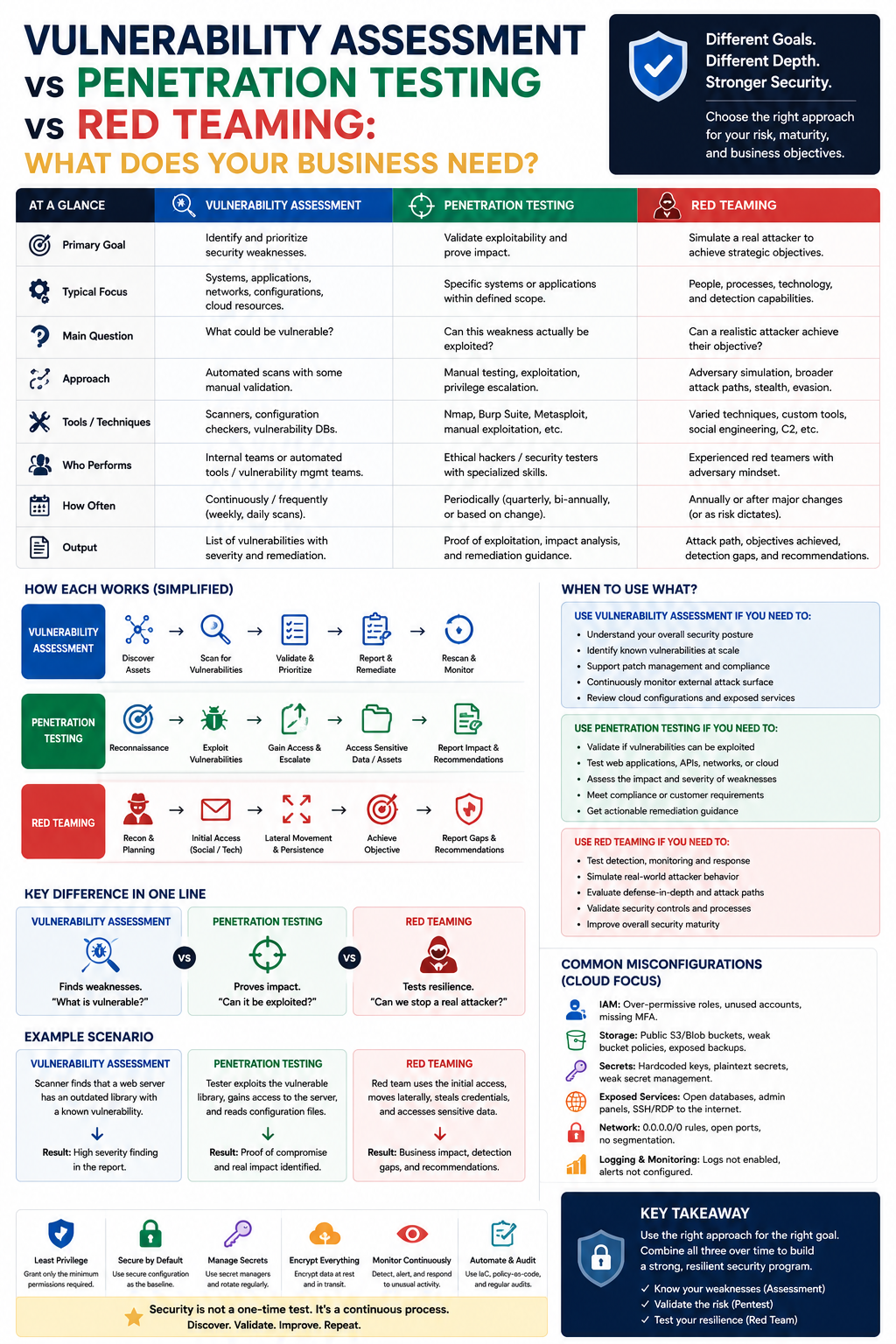
Cybersecurity is no longer just an IT concern. For businesses of every size, a single exploitable weakness can lead to data breaches, financial losses, operational disruption, regulatory penalties, and serious damage to customer trust.
That is why organizations regularly perform security assessments. But there is often confusion around three terms: Vulnerability Assessment (VA), Penetration Testing (PT), and Red Teaming.
Although these approaches are related, they answer very different security questions.
So, which one does your business actually need?
The answer depends on your organization's size, risk profile, compliance requirements, security maturity, and what you are trying to protect.
What Is a Vulnerability Assessment?
A Vulnerability Assessment is a systematic process of identifying, analyzing, and prioritizing security weaknesses across your systems, applications, networks, cloud environments, or devices.
Think of it as a security health check.
A vulnerability assessment typically uses automated scanning tools, combined with security expertise, to identify issues such as:
Outdated software and operating systems
Missing security patches
Weak configurations
Exposed services and ports
Known software vulnerabilities
Weak encryption configurations
Vulnerable web applications
Misconfigured cloud resources
Weak authentication settings
The results are generally categorized according to severity, helping organizations prioritize remediation.
When should you choose a Vulnerability Assessment?
A vulnerability assessment is particularly useful when your organization:
Wants to establish a baseline of its security posture
Has recently deployed new infrastructure
Needs regular vulnerability monitoring
Has a large number of assets to assess
Wants to identify known vulnerabilities quickly
Is beginning its cybersecurity program
Needs to prioritize security fixes
However, vulnerability scanning has an important limitation: finding a vulnerability does not necessarily prove that it can be exploited in your specific environment.
That's where penetration testing becomes valuable.
What Is Penetration Testing?
Penetration testing, commonly called pentesting, goes a step further.
Instead of simply identifying potential weaknesses, security professionals attempt to safely exploit vulnerabilities to determine whether they are actually exploitable and what impact they could have.
A penetration test can target areas such as:
Web applications
APIs
Mobile applications
External networks
Internal networks
Cloud environments
Wireless networks
Authentication mechanisms
For example, a vulnerability scanner might report that a web application has a potentially exploitable authentication weakness.
A penetration tester may investigate that finding and attempt to demonstrate whether an attacker could actually bypass authentication and gain unauthorized access.
The objective isn't simply to find vulnerabilities. It is to answer questions such as:
Can this vulnerability actually be exploited?
What could an attacker access if it were exploited?
How serious is the real-world impact?
When should you choose Penetration Testing?
Penetration testing is a strong choice when your organization:
Operates customer-facing applications
Handles sensitive information
Has recently launched a major application or API
Needs deeper validation after vulnerability scanning
Must satisfy security or compliance requirements
Wants to understand the real impact of vulnerabilities
Is preparing for an external security audit
Pentesting provides a more realistic assessment of individual attack paths than automated vulnerability scanning alone.
What Is Red Teaming?
Red teaming takes the concept even further.
Rather than focusing primarily on individual vulnerabilities, a red team attempts to simulate a real-world adversary and achieve a defined strategic objective.
The question changes from:
"What vulnerabilities exist?"
to:
"Could a determined attacker compromise our organization and achieve their objective without being detected?"
A red team may combine multiple techniques, including:
External reconnaissance
Social engineering
Physical security testing
Credential attacks
Web and application exploitation
Network attacks
Cloud attacks
Privilege escalation
Lateral movement
Persistence techniques
Security-control evasion
The red team's activities are typically designed around realistic attack scenarios and objectives.
For example, the objective might be to determine whether an attacker could gain access to a sensitive database while avoiding detection by the organization's security monitoring team.
Red teaming therefore evaluates not only vulnerabilities, but also the organization's people, processes, technology, monitoring, detection, and response capabilities.
When should you choose Red Teaming?
Red teaming is generally more appropriate for organizations with a mature security program, such as:
Large enterprises
Financial institutions
Technology companies
Organizations with valuable intellectual property
Businesses facing sophisticated threats
Organizations with established SOC or security teams
Companies that already perform regular vulnerability assessments and penetration tests
Red teaming is usually not the first security assessment a small organization should perform.
Vulnerability Assessment vs Penetration Testing vs Red Teaming
The simplest way to understand the difference is to look at their primary objectives:
Assessment | Primary Question | Main Focus | Typical Depth |
|---|---|---|---|
Vulnerability Assessment | What weaknesses exist? | Identifying and prioritizing vulnerabilities | Broad |
Penetration Testing | Can these weaknesses actually be exploited? | Exploitation and technical impact | Deep |
Red Teaming | Can a realistic attacker achieve an objective? | Attack simulation, detection, response | Very deep |
Another way to think about it:
Vulnerability Assessment → Find weaknesses
Penetration Testing → Exploit weaknesses
Red Teaming → Simulate an attacker
These aren't necessarily competing services. In a mature security program, they can complement one another.
Which One Does Your Business Need?
There is no universal answer.
Your choice should depend on your organization's current security maturity and objectives.
If you're building your security program
Start with a Vulnerability Assessment.
You need visibility before you can effectively manage risk. Identifying outdated systems, misconfigurations, and known vulnerabilities gives your security team a prioritized roadmap for remediation.
If you already understand your vulnerabilities
Consider Penetration Testing.
If your organization has addressed basic security weaknesses, pentesting can help determine whether attackers can actually exploit remaining weaknesses and what damage could result.
If you have a mature security operation
Consider Red Teaming.
If you already have vulnerability management, penetration testing, monitoring, and incident response capabilities, red teaming can test how those defenses perform against a realistic adversary.
A Practical Security Testing Strategy
For many businesses, the best approach isn't choosing only one.
A layered strategy can provide better coverage:
Step 1: Vulnerability Assessment
Identify known weaknesses across your environment.
↓
Step 2: Remediation
Fix, mitigate, or formally accept identified risks.
↓
Step 3: Penetration Testing
Validate whether important vulnerabilities can actually be exploited.
↓
Step 4: Red Team Exercise
Simulate a realistic attacker against the organization's broader defenses.
↓
Step 5: Improve Detection and Response
Use the findings to strengthen security controls, monitoring, incident response, and employee awareness.
This creates a continuous security improvement cycle rather than treating security testing as a one-time activity.
Don't Confuse Scanning With Security
One of the biggest mistakes organizations make is assuming that running a vulnerability scanner means they have completed a security assessment.
Automated tools are extremely useful, but they cannot fully understand business context, complex attack chains, human behavior, or every way an attacker might combine weaknesses.
Likewise, a penetration test does not guarantee that an organization is secure.
Security testing provides evidence about risk, not a permanent certificate of security.
New vulnerabilities appear. Systems change. Employees change roles. Applications are updated. Cloud environments evolve. Attack techniques continue to develop.
Security therefore needs to be treated as an ongoing process.
How Often Should Businesses Test?
The appropriate frequency depends on risk and business requirements.
Organizations should consider security testing:
Regularly as part of vulnerability management
After significant infrastructure changes
Before launching critical applications
After major application or architectural changes
Following significant security incidents
When compliance requirements demand it
As part of an ongoing security testing program
High-risk organizations may require more frequent and specialized testing than smaller businesses with limited exposure.
The Bottom Line
Vulnerability Assessment, Penetration Testing, and Red Teaming are not interchangeable.
A vulnerability assessment helps you understand what could be wrong.
Penetration testing helps you understand what can actually be exploited.
Red teaming helps you understand how your organization might perform against a realistic adversary.
For most businesses, the journey starts with visibility, moves toward validation, and eventually progresses toward realistic adversary simulation.
The most important question isn't:
"Which security test is the best?"
It's:
"What security question does my business need answered right now?"
Once you know that, choosing between vulnerability assessment, penetration testing, and red teaming becomes much easier.
Have a related challenge in mind?
Start a conversation