
Readers will understand what IDOR vulnerabilities are, how attackers exploit missing authorization checks, what risks they create, and how developers and security teams can prevent them
From the journal
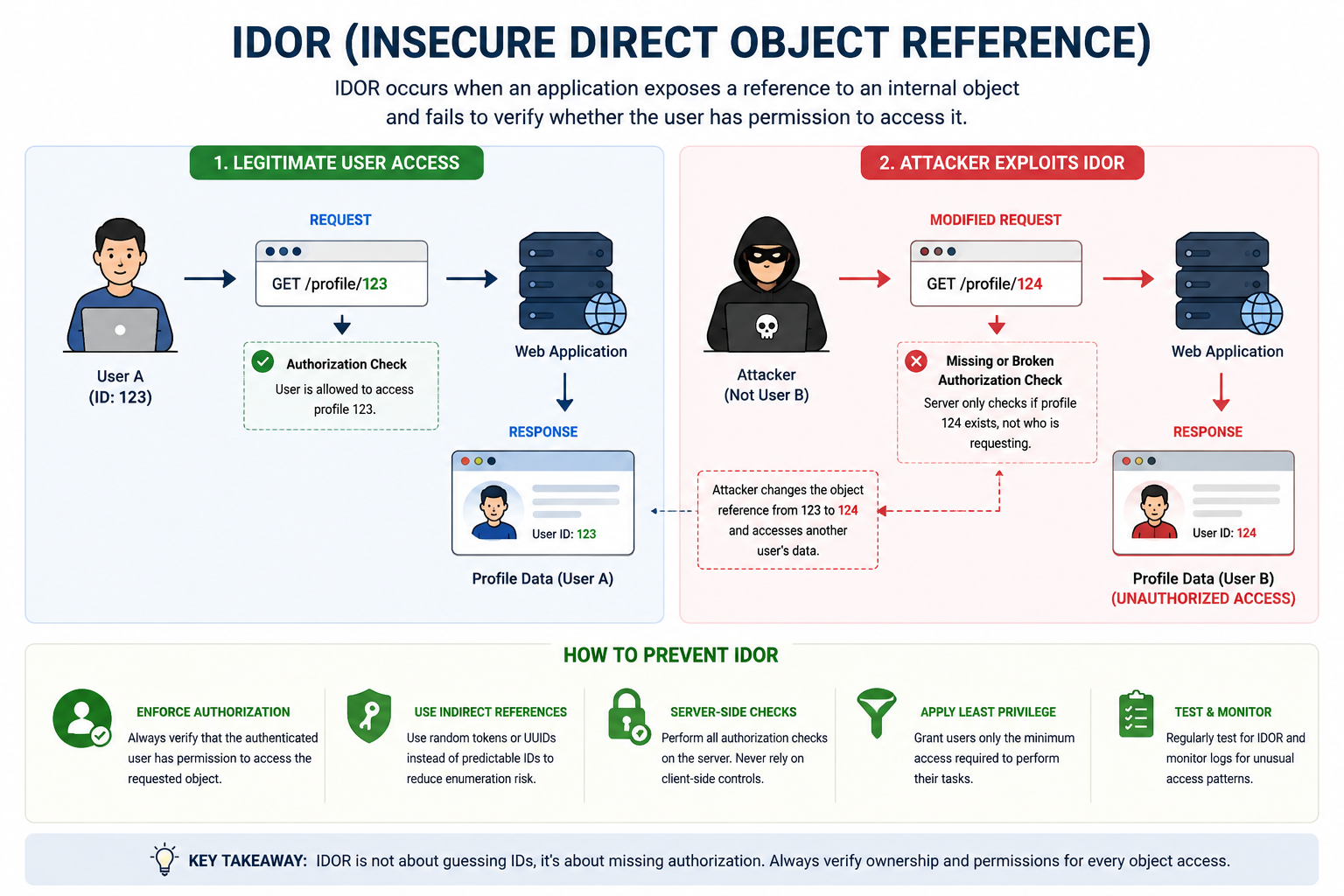
Insecure Direct Object Reference (IDOR) is an authorization vulnerability that occurs when an application exposes a reference to an internal object, such as a user ID, account number, document ID, or filename, without properly verifying whether the requesting user is authorized to access that object.
In simple terms, an IDOR vulnerability can occur when an application trusts an object identifier supplied by the client. For example, a request such as /profile/123 may display the profile belonging to user 123. If changing the identifier to /profile/124 allows another user to access information they should not be able to see, the application has an authorization weakness.
IDOR vulnerabilities are not limited to profile pages. They can affect invoices, customer records, support tickets, files, orders, API resources, payment information, and other objects that are referenced through predictable or user-controlled identifiers.
A typical IDOR scenario begins with a legitimate request containing an object reference. An attacker then modifies that reference and sends the request again. If the server checks only whether the object exists, rather than whether the current user has permission to access it, unauthorized data may be returned.
The impact of IDOR can range from unauthorized data disclosure to modification or deletion of another user's resources. Depending on the affected functionality, an attacker may gain access to personal information, business records, confidential documents, financial data, or administrative functionality.
One common root cause is implementing authentication without implementing proper authorization. Authentication answers the question, "Who are you?" Authorization answers the more important question, "Are you allowed to access this specific resource?" A user being successfully logged in does not automatically mean they are authorized to access every object in the application.
Developers should enforce authorization checks on the server side for every sensitive object and every relevant operation. The application should verify that the authenticated user has permission to read, modify, or delete the requested resource before performing the operation.
Using random identifiers such as UUIDs can make object enumeration more difficult, but changing an integer ID to an unpredictable value is not a complete fix for IDOR. Strong authorization controls must remain in place because an attacker may obtain valid identifiers through other application functionality, logs, URLs, responses, or leaked data.
For APIs, authorization should be validated consistently across endpoints and HTTP methods. Security teams should test GET, POST, PUT, PATCH, and DELETE operations where applicable, because an application may correctly restrict viewing a resource while accidentally allowing unauthorized modification or deletion.
Security testing should include attempts to access another user's resources, modify object identifiers, replay requests with different identifiers, and test resources belonging to different roles or tenants. Automated security testing can help identify authorization issues, while manual testing is often valuable for understanding complex access-control relationships.
The best defense against IDOR is a centralized and consistently enforced authorization model based on the authenticated user's permissions and ownership of the requested resource. Applying least privilege, performing server-side authorization checks, reviewing access-control logic during code review, and regularly testing authorization boundaries can significantly reduce the risk of IDOR vulnerabilities.
IDOR is ultimately an access-control problem rather than simply an issue with predictable IDs. Secure applications should never assume that because a user can supply an object identifier, they are entitled to access the corresponding object.
Have a related challenge in mind?
Start a conversation