
15 min read, Readers will understand the major API security risks organizations should assess, how these vulnerabilities can be exploited, the potential business impact, and the security controls and testing practices that can reduce API-related risk.
From the journal
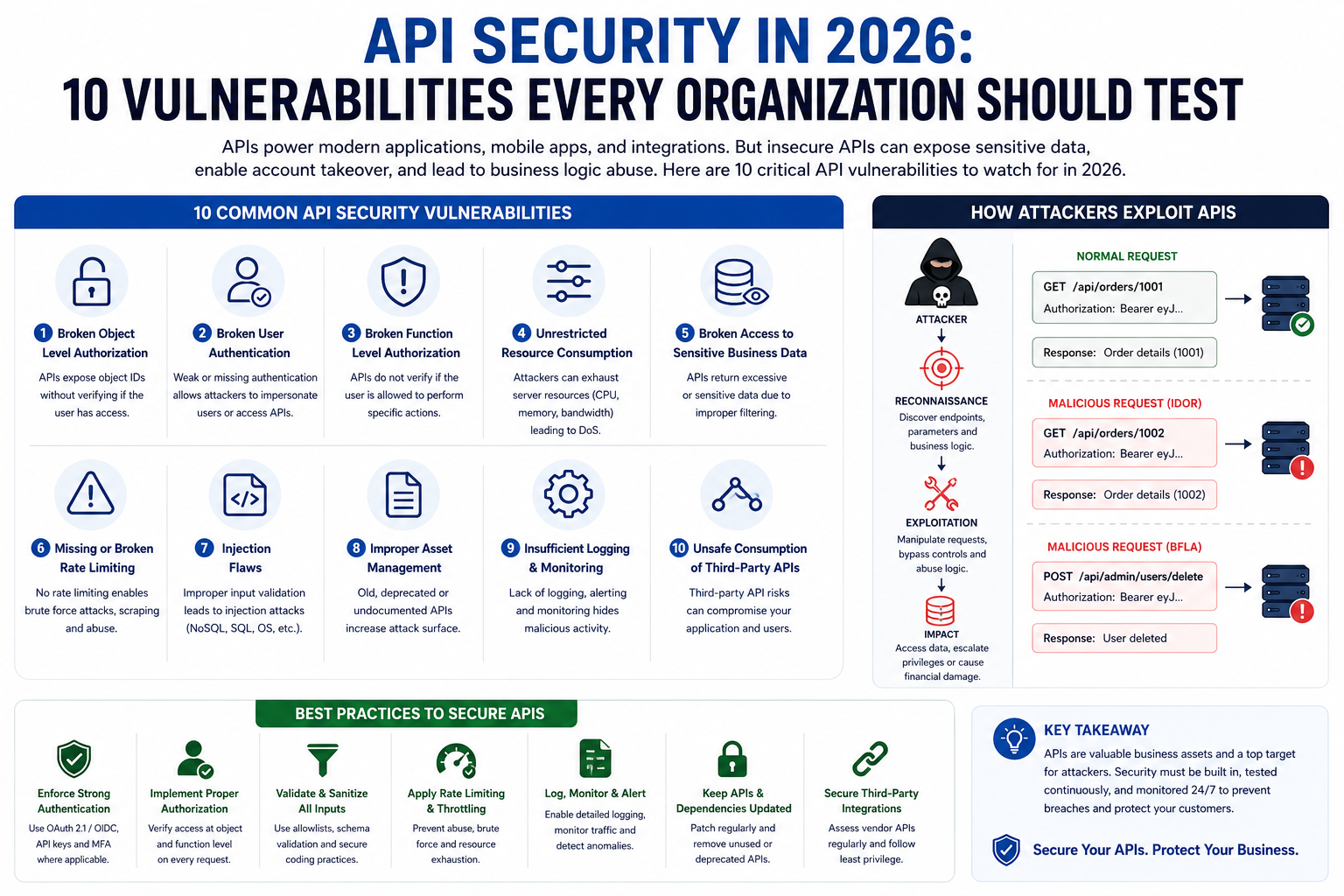
Application Programming Interfaces (APIs) have become a fundamental part of modern software. Web applications, mobile applications, SaaS platforms, cloud services, payment systems, IoT platforms, and internal microservices all depend on APIs to exchange data and perform business operations. Because APIs directly expose application functionality and often handle sensitive information, they are an increasingly important attack surface. OWASP describes APIs as a critical component of modern applications and maintains a dedicated API Security Top 10 to address API-specific risks.
When discussing API security in 2026, it is important to distinguish between the current dedicated OWASP API Security Top 10 and the broader OWASP Top 10. The dedicated API Security Top 10 currently published by OWASP is the 2023 edition, while the broader OWASP Top 10 was updated to its 2025 release. This article uses the API-specific risks as its foundation while putting them into a current 2026 security-testing context.
1. Broken Object Level Authorization (BOLA/IDOR)
Broken Object Level Authorization occurs when an API uses an object identifier supplied by the client but fails to verify whether the authenticated user is authorized to access that specific object. An attacker may change a customer ID, invoice ID, order ID, document ID, or UUID and obtain another user's information or perform an unauthorized action. OWASP identifies this as API1:2023 and notes that object-level authorization must be checked whenever client-supplied identifiers are used to access records.
For example, a request such as /api/orders/1001 may legitimately return a user's own order. If changing the identifier to /api/orders/1002 returns another customer's order, the API has an authorization failure. Security testing should validate access using multiple identities and verify that users cannot read, modify, or delete resources belonging to other users or tenants. OWASP's API Security Testing Framework specifically includes BOLA/IDOR testing through identifier manipulation and cross-user access checks.
2. Broken Authentication
API authentication weaknesses can allow attackers to impersonate users, reuse stolen tokens, bypass authentication controls, or exploit implementation errors in session and token handling. Risks include weak password policies, improperly validated JWTs, long-lived credentials, insecure API keys, missing multi-factor authentication for sensitive operations, and authentication endpoints that allow brute-force or credential-stuffing attacks. OWASP lists Broken Authentication as API2:2023 because compromising the API's ability to reliably identify the caller can undermine the entire security model.
Testing should examine token validation, expiration, revocation, session handling, authentication bypasses, password-reset workflows, MFA enforcement, rate limiting, and privilege transitions. Authentication should also be evaluated differently from authorization: proving who a caller is does not prove that the caller is permitted to access a particular resource or perform a particular function.
3. Broken Object Property Level Authorization
An API may correctly restrict access to an object while still exposing or allowing changes to individual properties that the user should not control. This can lead to excessive data exposure or mass-assignment-style problems. For example, a normal user may be able to update their profile but should not be able to submit fields such as role=admin, accountStatus=verified, or internal billing attributes.
OWASP combines excessive data exposure and mass assignment under API3:2023 because the root problem is inadequate authorization at the property level. Testing should inspect both response bodies and request bodies to determine whether sensitive fields are unnecessarily returned or whether protected properties can be modified by unauthorized users.
4. Unrestricted Resource Consumption
Every API request consumes resources such as CPU, memory, bandwidth, storage, database capacity, or external service quotas. A vulnerable API may allow an attacker to send excessive requests, submit expensive operations, upload oversized payloads, or trigger repeated downstream actions. The result can be denial of service, degraded performance, or unexpected infrastructure and third-party costs. OWASP specifically highlights these risks under API4:2023.
Security testing should examine rate limits, request-size limits, pagination limits, concurrency controls, expensive database operations, file uploads, and integrations that incur per-request charges. Rate limiting should be designed around actual business requirements rather than applied as a single global threshold. OWASP's REST security guidance also recommends appropriate API controls and returning HTTP 429 responses when request rates exceed defined limits.
5. Broken Function Level Authorization
Function-level authorization determines whether a particular user or role is allowed to perform an action. This becomes dangerous when administrative or privileged endpoints are exposed to ordinary users. For example, an application may properly authenticate a user but accidentally allow that user to invoke an administrative endpoint by changing the path, HTTP method, or request parameters.
OWASP lists this as API5:2023 and emphasizes the difficulty of maintaining complex authorization policies across user hierarchies and application functions. Testing should compare permissions across roles and attempt to access administrative operations using lower-privileged accounts. OWASP's API testing framework includes tests for inaccessible admin endpoints, HTTP method escalation, and privilege-tier path substitution.
6. Unrestricted Access to Sensitive Business Flows
Not every API abuse scenario involves a traditional software vulnerability. An API may be technically functioning as designed while still exposing a business process that can be automated at harmful scale. Examples include account creation, password-reset requests, ticket purchases, coupon redemption, reservations, referral programs, voting, payment actions, or high-demand product purchases.
OWASP identifies this as API6:2023 and notes that attackers can automate sensitive business flows to cause fraud, spam, scalping, resource abuse, or financial damage. Effective defenses may require a combination of rate limits, identity-aware controls, behavioral analysis, device signals, transaction limits, and business-specific anti-automation measures.
7. Server-Side Request Forgery (SSRF)
SSRF occurs when an API retrieves a user-controlled URL or remote resource without adequately restricting where the server is allowed to connect. An attacker may attempt to make the application send requests to internal services, cloud metadata endpoints, management interfaces, or other resources that are not directly reachable from the Internet.
SSRF is particularly relevant to APIs that provide webhooks, URL previews, remote file retrieval, import functions, document processing, or integrations with external services. OWASP includes SSRF as API7:2023 and recommends strict validation of remote destinations and secure handling of user-controlled URLs.
8. API Security Misconfiguration
API security can be weakened by configuration mistakes such as overly permissive CORS policies, unnecessary HTTP methods, verbose error messages, exposed debugging interfaces, weak TLS settings, insecure default configurations, missing security headers, or inconsistent gateway protections. A single configuration error can expose an otherwise well-designed API.
Security testing should cover production, staging, development, and test environments because organizations sometimes secure the primary production endpoint while leaving older or alternate environments less protected. OWASP's API Security Top 10 identifies Security Misconfiguration as API8:2023 and recommends treating supporting infrastructure and all exposed API versions as part of the security boundary.
9. Improper API Inventory and Asset Management
Organizations cannot secure APIs they do not know exist. Modern environments may contain public APIs, internal APIs, partner integrations, legacy versions, staging deployments, development hosts, forgotten endpoints, undocumented services, and APIs created by different teams. As software architectures become more distributed, maintaining an accurate API inventory becomes increasingly important.
OWASP's API9:2023 recommends maintaining an inventory of API hosts, environments, versions, integrated services, data flows, authentication requirements, and endpoints. Organizations should also define a retirement strategy for old versions and avoid exposing production data through poorly protected non-production deployments.
10. Unsafe Consumption of Third-Party APIs
Organizations increasingly depend on external APIs for payments, identity verification, messaging, analytics, maps, AI services, shipping, fraud detection, and other business functions. A common mistake is assuming that data received from a trusted third-party API is automatically safe. Developers may apply weaker validation and security controls to external responses than they would to direct user input.
OWASP calls this API10:2023 Unsafe Consumption of APIs. Risks can include injection, sensitive data exposure, denial of service, unsafe redirects, insecure transport, and weaknesses in the external service itself. Third-party API responses should therefore be treated as untrusted input, validated before use, protected with appropriate timeouts and resource limits, and transmitted securely.
Why API Security Testing Matters in 2026
API security testing should no longer be treated as a one-time activity performed immediately before production release. APIs change continuously as development teams add endpoints, introduce new microservices, change authorization rules, integrate third-party platforms, and release new versions. OWASP specifically notes that authorization problems can reappear when features are added or modified, which is why automated authorization regression testing is valuable alongside periodic penetration testing.
A mature API security program should combine automated testing, manual security assessment, secure API design, continuous inventory, strong authentication and authorization, rate limiting, monitoring, and regular penetration testing. Testing should cover both technical vulnerabilities and abuse of legitimate business functionality. It should also verify that security controls remain effective as APIs evolve.
What Organizations Should Test
A practical API security assessment should examine authentication and token handling, horizontal and vertical authorization, object and property-level access controls, rate limiting, business-logic abuse, input validation, SSRF, API gateway configuration, deprecated versions, undocumented endpoints, sensitive data exposure, third-party integrations, and security logging. Where possible, these tests should be performed with multiple user roles and tenant contexts so that access-control boundaries can be verified rather than assumed. OWASP's API Security Testing Framework provides test coverage for many of these areas, including BOLA, authentication, property authorization, resource consumption, function-level authorization, business-flow abuse, and SSRF.
How to Secure APIs More Effectively
The strongest API security strategy is layered. Organizations should enforce least-privilege authorization, validate permissions on every sensitive request, implement strong authentication, establish appropriate rate and resource limits, maintain a complete API inventory, remove or secure deprecated versions, validate third-party data, monitor suspicious activity, and continuously test authorization behavior. OWASP recommends denying access by default, validating permissions on every request, applying least privilege, logging security-relevant activity, and creating automated tests for authorization logic.
Final Takeaway
APIs are now a primary interface to business data and business functionality, which makes them an attractive target for attackers. The most serious API risks are not limited to traditional injection vulnerabilities. Broken authorization, weak authentication, resource abuse, sensitive business-flow automation, SSRF, inventory gaps, configuration mistakes, and unsafe third-party integrations can all create significant technical and business risk.
For organizations operating APIs in 2026, the objective should be more than simply asking whether an endpoint is reachable and authenticated. Security teams should verify who can access each resource, what each user can do, how much an API can be abused, what hidden or legacy interfaces exist, and how the API behaves when connected to other systems. Continuous API security testing, combined with secure design and strong authorization controls, helps organizations reduce exposure before vulnerabilities become incidents.
Have a related challenge in mind?
Start a conversation