
15 min read, Understand how API abuse and business logic attacks work, including object-level authorization flaws, price manipulation, workflow bypasses, race conditions, excessive functionality, and resource abuse—and learn practical techniques to secure APIs against them.
From the journal
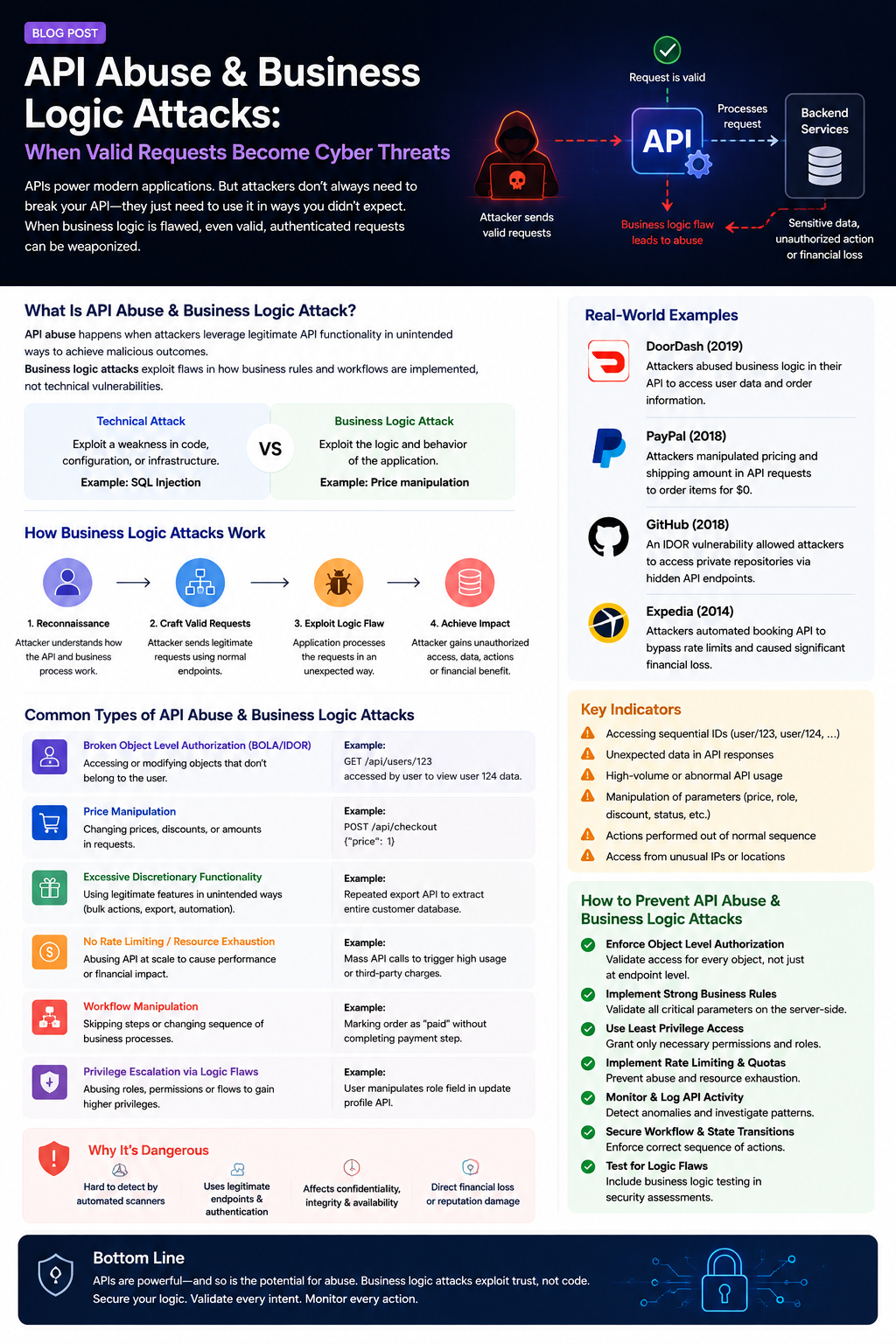
APIs are the backbone of modern applications.
Mobile apps, web applications, payment systems, SaaS platforms, marketplaces, banking systems, and cloud services all rely on APIs to move data and perform actions.
Most API security discussions focus on traditional vulnerabilities:
SQL injection
Authentication bypass
Cross-site scripting
Remote code execution
Broken encryption
But there is another category of threat that is often much harder to detect:
The API does exactly what it was designed to do—but an attacker uses it in a way the business never intended.
This is where API abuse and business logic attacks become dangerous.
The requests may be authenticated.
The parameters may be valid.
The HTTP responses may return 200 OK.
And yet the attacker can still cause financial loss, access unauthorized information, abuse resources, or manipulate a business workflow.
What Is API Abuse?
API abuse occurs when an attacker uses legitimate API functionality in an unintended or harmful way.
The attacker may not need to exploit a technical vulnerability.
Instead, they understand how the API works and discover ways to combine legitimate operations to achieve an unauthorized outcome.
Consider a simple e-commerce workflow:
Add Product
     ↓
Apply Discount
     ↓
Checkout
     ↓
Payment
     ↓
Order Confirmed
Every endpoint may be individually secure.
But what happens if an attacker discovers that they can:
Apply Discount
     ↓
Change Cart
     ↓
Apply Discount Again
     ↓
Checkout
The API may accept every request.
The problem isn't necessarily the API endpoint.
The problem is the business logic connecting those endpoints.
Technical Vulnerability vs. Business Logic Vulnerability
This distinction is extremely important.
A traditional technical vulnerability might look like:
Malicious Input
      ↓
SQL Injection
      ↓
Database Compromise
A business logic attack might look like:
Valid Request
      ↓
Valid Authentication
      ↓
Valid API Endpoint
      ↓
Unexpected Sequence
      ↓
Unauthorized Business Outcome
There may be no malformed request at all.
The attacker simply uses the system differently from what the developers expected.
How Business Logic Attacks Work
A typical attack involves four stages.
1. Understand the Application
Attackers study:
API documentation
Mobile applications
JavaScript bundles
API responses
Error messages
Request patterns
Account workflows
They try to understand how the business operates.
2. Identify Trust Assumptions
The attacker asks questions such as:
Can I change this value?
Can I repeat this request?
Can I perform this action twice?
What happens if I skip this step?
Can I access another user's object?
Can I change an operation after it has been approved?
What happens if two requests happen simultaneously?
These questions reveal business logic weaknesses.
3. Combine Legitimate Operations
The attacker doesn't necessarily need a special exploit.
They may simply combine normal API operations in an unexpected order.
For example:
Create Order
      ↓
Apply Discount
      ↓
Change Quantity
      ↓
Apply Discount Again
      ↓
Complete Checkout
Every request is legitimate.
The final outcome isn't.
4. Monetize or Exploit the Result
Depending on the application, the attacker might achieve:
Financial gain
Unauthorized purchases
Data access
Account takeover
Free resources
Loyalty-point abuse
Privilege escalation
Resource exhaustion
Common Types of API Abuse
1. Broken Object Level Authorization
One of the most common API security problems is failing to verify whether the authenticated user is allowed to access a specific object.
Imagine:
GET /api/users/1001/orders
The application correctly verifies that the attacker is logged in.
But does it verify that user 1001 actually owns those orders?
If not, authentication exists—but authorization is broken.
The important distinction is:
"Who are you?"
versus:
"Are you allowed to access this specific resource?"
Every object-level operation needs the second check.
2. Price Manipulation
Consider an API request containing:
{
  "productId": 42,
  "quantity": 1,
  "price": 10
}
If the server trusts the client-provided price, an attacker may attempt to modify it.
The fundamental rule should be:
Never trust the client to determine security-sensitive business values.
The server should calculate prices based on trusted data:
Product
   ↓
Server-side price
   ↓
Discount rules
   ↓
Tax
   ↓
Final amount
The client should request an action—not dictate the outcome.
3. Coupon and Discount Abuse
Discount systems are particularly vulnerable to business logic problems.
An attacker may attempt to:
Reuse single-use coupons
Stack incompatible discounts
Apply discounts after payment
Transfer coupons between accounts
Modify eligibility parameters
Exploit rounding behavior
Race multiple redemption requests
For example:
Coupon:
ONE-TIME-50

Expected:
Account → Redeem → Used

Potentially vulnerable:
Request A → Redeem
Request B → Redeem
Request C → Redeem
If the system doesn't enforce the business rule atomically, the attacker may redeem something multiple times.
4. Workflow Manipulation
Many applications depend on a specific sequence of actions.
For example:
Pending
   ↓
Payment
   ↓
Verified
   ↓
Shipped
   ↓
Completed
A vulnerable system may allow:
Pending
   ↓
Completed
without enforcing the required intermediate states.
This can lead to serious problems.
The API must enforce state transitions, not simply expose endpoints.
5. Excessive Functionality
An API may expose powerful operations that are legitimate for certain users but dangerous when abused.
Examples include:
Bulk exports
Mass updates
Account automation
Administrative actions
Large search queries
Data synchronization
Batch processing
Even if the endpoint is properly authenticated, unrestricted access can become an abuse vector.
6. Rate Limit and Resource Abuse
An API might work perfectly for one request.
The problem appears when someone sends:
1 request
10 requests
1,000 requests
1,000,000 requests
Potential consequences include:
Resource exhaustion
Increased cloud costs
Database overload
SMS or email abuse
API quota exhaustion
Third-party billing
Denial of service
Rate limiting isn't just a performance feature.
It can also be a business security control.
7. Privilege Escalation Through Business Logic
Sometimes users can modify fields that influence authorization.
For example:
{
  "name": "John",
  "role": "admin"
}
If the server blindly accepts the entire object, an ordinary user may attempt to modify their own role.
The correct approach is to explicitly control which fields users are allowed to change.
For example:
Allowed:
name
email

Protected:
role
permissions
accountStatus
billingStatus
8. Race Conditions
Business logic attacks can become even more interesting when requests happen concurrently.
Imagine an account has:
Balance: $100
and an API allows a $100 withdrawal.
Two requests arrive almost simultaneously.
If the system checks the balance before either transaction is committed, both requests might succeed.
Expected:
$100
 ↓
Withdraw $100
 ↓
$0
Vulnerable:
Request A → Check: $100 available
Request B → Check: $100 available

Request A → Withdraw
Request B → Withdraw

Result → $200 withdrawn
This is why financial and state-changing operations often require transactional controls and atomic business rules.
Why Business Logic Attacks Are Difficult to Detect
Traditional security tools are good at identifying suspicious technical patterns.
For example:
' OR 1=1 --
is obviously suspicious.
But this request:
POST /api/checkout
might be completely legitimate.
The problem may be that the attacker has performed the request:
Too many times
At the wrong stage
Against the wrong object
In an unusual sequence
With a manipulated business parameter
From the API's perspective:
HTTP 200 OK
Everything looks normal.
This creates a major detection challenge.
Why Authentication Alone Isn't Enough
One of the most dangerous assumptions in API security is:
"The endpoint is protected because the user is logged in."
Authentication only establishes identity.
Security also requires authorization and business-rule validation.
Think of the layers as:
Authentication
      ↓
Authorization
      ↓
Input Validation
      ↓
Business Rules
      ↓
State Validation
      ↓
Transaction Controls
      ↓
Rate Limits
Skipping any of these can create an abuse opportunity.
How to Protect APIs From Business Logic Attacks
1. Enforce Authorization at the Object Level
Don't just ask:
Is the user authenticated?
Also ask:
Does this user own or have permission to modify this specific object?
Every sensitive resource should be checked independently.
2. Never Trust Client-Controlled Business Values
The client should not determine:
Final price
User role
Account status
Permissions
Payment state
Discount eligibility
Ownership
Calculate sensitive values on the server.
3. Enforce State Transitions
Represent business workflows explicitly.
For example:
DRAFT
  ↓
SUBMITTED
  ↓
APPROVED
  ↓
PAID
  ↓
COMPLETED
Don't allow arbitrary transitions simply because the API endpoint exists.
The server should verify:
Current State
      +
Requested Action
      ↓
Is Transition Allowed?
4. Make Sensitive Operations Idempotent
Operations involving payments, orders, and financial transactions should be designed carefully to prevent accidental or malicious duplication.
Use mechanisms such as:
Idempotency keys
Unique transaction identifiers
Database constraints
Atomic operations
Transaction boundaries
The goal is to ensure that repeating a request doesn't accidentally repeat its business effect.
5. Implement Meaningful Rate Limits
Don't use one generic limit for everything.
Different operations have different risk levels.
For example:
GET /products
→ High volume allowed

POST /login
→ Strict limit

POST /send-money
→ Very strict limit

POST /send-verification-code
→ Strict limit
Rate limits should reflect the potential impact of the operation.
6. Monitor Behavior, Not Just Errors
A secure API should monitor patterns such as:
Unusual request volume
Sequential object access
Repeated failed authorization
Abnormal transaction patterns
Coupon abuse
Rapid account creation
Large exports
Unusual geographic behavior
Repeated state transitions
Unexpected API sequences
The important question isn't only:
"Did the API return an error?"
It is also:
"Does this behavior make sense for a legitimate user?"
7. Test Business Logic Explicitly
Automated vulnerability scanners can't understand your entire business model.
Security testing should therefore include scenarios such as:
Authorization
Can User A access User B's object?
Workflow
Can an order skip payment?
Financial
Can a discount be applied twice?
Concurrency
Can two simultaneous requests perform the same transaction?
State
Can a completed transaction be changed back to pending?
Limits
Can one user consume an unlimited resource?
These are business questions—not just technical questions.
Secure API Design Starts With Business Rules
One useful approach is to define business invariants explicitly.
For example:
An order cannot be shipped before payment succeeds.

A coupon can only be redeemed once.

A user can only modify their own profile.

A refund cannot exceed the original payment.

A completed transaction cannot be modified.

A normal user cannot assign administrative roles.
These rules should exist on the server.
They should not exist only in:
Frontend JavaScript
Mobile applications
UI buttons
Client-side validation
Anything enforced only by the client can potentially be bypassed.
A Practical API Security Model
A mature API should think about every sensitive operation like this:
Request
   ↓
Authenticate
   ↓
Authorize
   ↓
Validate Input
   ↓
Check Object Ownership
   ↓
Validate Business Rules
   ↓
Validate State Transition
   ↓
Apply Rate / Resource Limits
   ↓
Execute Atomically
   ↓
Audit & Monitor
This approach makes it much harder for an attacker to turn legitimate functionality into an unintended capability.
The Developer's Checklist
Before releasing an API, ask:
Can users access objects they don't own?
Can sensitive parameters be changed from the client?
Can an operation be repeated?
Can requests be executed out of order?
Can workflows skip required states?
Can discounts or promotions be abused?
Can users manipulate prices or quantities?
Are high-value operations rate-limited?
Are race conditions possible?
Can users modify protected fields?
Are authorization checks performed on every sensitive object?
Are business rules enforced server-side?
Are unusual API sequences monitored?
Have abuse scenarios been tested?
Final Thoughts
API security isn't only about stopping malicious requests.
Some of the most dangerous attacks use perfectly valid requests.
The attacker authenticates normally.
They call real endpoints.
They send valid JSON.
The server responds with 200 OK.
And yet the attacker achieves something they were never supposed to be able to do.
That's what makes business logic attacks so difficult.
The API isn't necessarily broken. The assumptions behind the API are.
Modern API security therefore needs to go beyond authentication and input validation.
It must understand:
Who is making the request?
What resource are they accessing?
What state is the system in?
What business action are they attempting?
Is that action allowed?
How often can it happen?
What happens if they repeat it or perform it concurrently?
The most secure APIs don't simply validate requests.
They validate intent, authorization, state, and business consequences.
Because sometimes the most dangerous request is not the one that looks malicious.
It's the one that looks completely legitimate.
Have a related challenge in mind?
Start a conversation