
15 min read, Readers will understand excessive agency in AI agents, how autonomous systems can be abused or manipulated, the risks of overly broad permissions and tool access, and the controls organizations should implement to build safer agentic AI applications.
From the journal
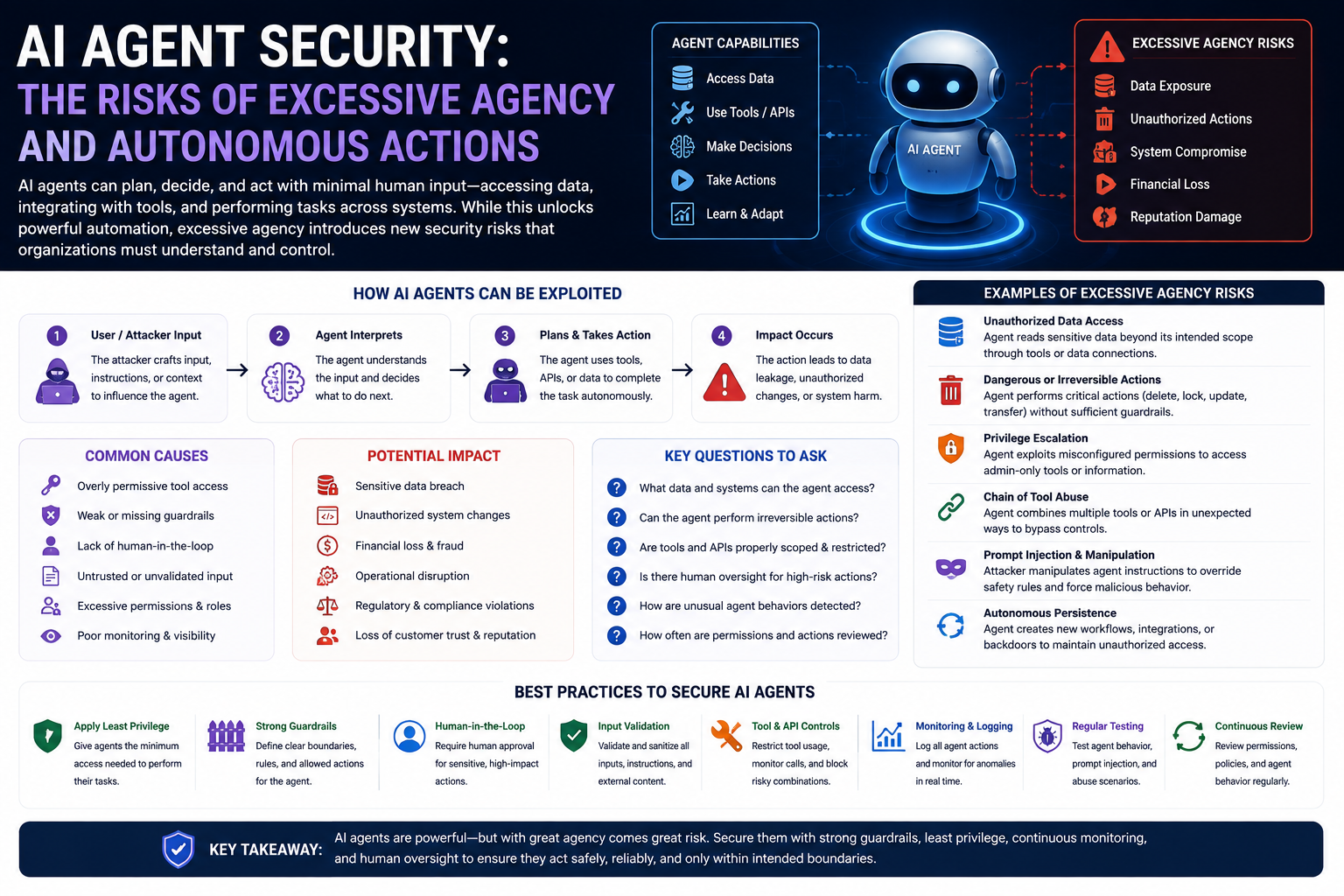
Artificial intelligence is moving beyond chatbots that simply generate responses. Modern AI agents can plan tasks, retrieve information, interact with APIs, call external tools, update records, send messages, create workflows, and make decisions with limited human intervention. This shift from generation to action creates a new security challenge: an AI system may have enough authority to cause real-world impact if its behavior is manipulated, misunderstood, or poorly constrained. OWASP's 2026 Top 10 for Agentic Applications specifically addresses the security risks introduced by autonomous and agentic AI systems.
One of the key concepts is excessive agency. OWASP defines excessive agency as a condition in which an LLM-based application can perform damaging actions because it has excessive functionality, excessive permissions, or excessive autonomy. These actions may be triggered by manipulated input, prompt injection, unexpected model behavior, compromised extensions, or other conditions that cause the agent to act outside its intended boundaries.
The difference between a traditional AI assistant and an AI agent is important. A chatbot might answer a question about an invoice, while an agent could retrieve the invoice, update a payment record, contact a customer, or initiate another workflow. The more systems an agent can access and the more actions it can perform, the greater the potential impact when something goes wrong.
Imagine an internal company agent designed to help employees find documents. It only needs permission to search and read approved files. During development, however, the agent is connected to a tool that also allows files to be modified or deleted. If the unnecessary capabilities remain available, a manipulated prompt or unexpected model decision could turn a simple document-search assistant into a system capable of destructive actions. OWASP uses this type of excessive functionality as a core example of excessive agency.
Excessive permissions create a second layer of risk. An agent may require access to a customer database, cloud environment, CRM system, email platform, source-code repository, or financial application. Granting it broad access for convenience increases the consequences of mistakes or compromise. An agent should have only the permissions needed for its specific task, using the same least-privilege principle applied to human users and traditional applications.
Excessive autonomy is equally important. Some operations should not be completed automatically, especially when they are irreversible, financially sensitive, externally visible, or capable of changing security controls. Deleting data, changing permissions, approving payments, modifying infrastructure, sending sensitive communications, or publishing content may require an independent approval step instead of unrestricted autonomous execution.
AI agents can also be attacked through their surrounding environment. A prompt injection may manipulate the agent's goal, while a malicious document, web page, email, tool response, or connected service can provide instructions that the agent incorrectly treats as trusted input. OWASP's 2026 agentic guidance highlights Agent Goal Hijacking, Tool Misuse and Exploitation, and Identity and Privilege Abuse among the major risks facing agentic systems.
Tool access deserves particular attention. Agents often depend on functions such as database queries, search tools, file operations, code execution, browser access, cloud APIs, and external business services. A tool itself may be legitimate and securely implemented, yet an agent can still use it in an unsafe way. OWASP categorizes this as Tool Misuse and Exploitation, noting that an agent may misuse legitimate tools because of prompt injection, unsafe delegation, ambiguous instructions, or other failures.
Another concern is identity and privilege abuse. Agents often operate through service accounts, API keys, delegated credentials, or application identities. If those identities have more privileges than necessary, a compromised or manipulated agent may inherit the ability to access resources far beyond its intended scope. OWASP's 2026 agentic framework treats identity and privilege abuse as a distinct security risk because agent actions can cross trust boundaries very quickly when credentials and permissions are poorly controlled.
The potential impact can be significant. A manipulated agent might expose sensitive information, alter business records, send unauthorized messages, change configuration, delete data, access restricted resources, trigger expensive cloud operations, or create a chain of unintended actions across multiple systems. The impact depends heavily on the agent's connected tools, permissions, identity, and level of autonomy.
Multi-agent architectures introduce another challenge. One agent may delegate work to another agent, which may call additional services or tools. A problem in one component can therefore propagate through the workflow. OWASP's current agentic security guidance also highlights issues such as cascading failures, memory poisoning, insecure inter-agent communication, supply-chain vulnerabilities, and rogue-agent behavior.
The first defense is least privilege. Before deploying an agent, organizations should define exactly what data it needs, which tools it needs, which systems it needs to access, and which actions it genuinely needs to perform. Everything else should be removed or denied by default. An agent that only needs to read customer information should not receive write access, and an agent that only needs to send draft messages should not receive unrestricted permission to send them.
The second defense is strong tool and action boundaries. Each tool should have a narrow purpose, well-defined input and output schemas, explicit authorization checks, and clear limits. Sensitive operations should be separated from low-risk operations. For example, reading an account balance might be low risk, while transferring money, changing account ownership, or disabling security controls should require stronger controls.
Organizations should also introduce human approval for high-impact actions. Human-in-the-loop or human-on-the-loop controls can provide an additional barrier before an agent performs irreversible or sensitive operations. The approval process should be implemented outside the model so that the model cannot simply instruct itself to bypass the approval requirement.
Input validation and trust separation are also essential. User prompts, retrieved documents, tool responses, external APIs, emails, and web content should be treated as untrusted data. An agent should not automatically treat instructions found in external content as authorized commands. Security-critical authorization decisions should be enforced by deterministic application controls rather than delegated entirely to a language model.
Monitoring is another major requirement. Organizations should record important agent actions, tool invocations, identity context, permission checks, failures, and unusual behavior. Security teams can then detect abnormal tool usage, unexpected data access, repeated high-risk actions, unusual workflow chains, or attempts to reach resources outside the agent's normal operating pattern. OWASP's current agent security guidance emphasizes architectural monitoring and security controls throughout the agent lifecycle.
Agent security should also be tested continuously. Traditional penetration testing alone may not identify all agentic risks because the attack surface includes prompts, tools, memory, model decisions, delegation, identity, and dynamic workflows. OWASP's 2026 security work specifically promotes agentic AI red teaming as a way to identify issues such as prompt injection, privilege escalation, tool misuse, data poisoning, and emergent behavior across the lifecycle.
Testing should include scenarios such as prompt-based goal manipulation, unauthorized tool invocation, privilege escalation, access to restricted data, destructive action attempts, unsafe delegation, credential misuse, malicious external content, excessive loops, and unexpected combinations of otherwise legitimate tools. Security teams should evaluate not only what the agent is designed to do, but also what it can do when its inputs, tools, or decision process are manipulated.
A useful security principle is simple: the more an agent can do, the more carefully its permissions and autonomy must be controlled. AI systems should not receive broad access simply because they might need it someday. Capabilities should be deliberately scoped, monitored, reviewed, and removed when they are no longer necessary.
Final Takeaway
AI agents can deliver powerful automation, but autonomy changes the security model. A vulnerable application that leaks information is serious; an AI agent that can leak information, modify systems, call privileged APIs, and continue acting without human intervention can turn the same weakness into a much larger incident.
Organizations deploying AI agents in 2026 should therefore treat agency as a security boundary. Apply least privilege, restrict tools and identities, separate high-impact actions, validate inputs and outputs, require approval where appropriate, monitor behavior continuously, and regularly perform adversarial testing. OWASP's 2026 Agentic Applications Top 10 provides a useful framework for understanding these emerging risks and designing stronger defenses.
Have a related challenge in mind?
Start a conversation